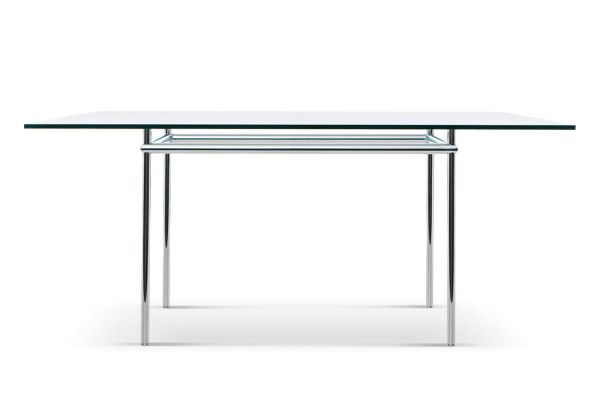


The LC12 Table La Roche by Cassina, designed by Le Corbusier and Pierre Jeanneret in 1925 for Maison La Roche in Paris, embodies a bold interplay of contrasts between structure and surface. Its expressive power stems from a reversal of roles: the support becomes visually fragile, while the top, apparently light, reveals a decisive material presence. A poetic and rational gesture that gives life to a minimalist, elegant and surprising piece of furniture.
The base, reduced to the essentials, consists of a thin tubular steel structure, available in a polished or painted finish, which extends centrally under the rectangular top, leaving the four ends free and 'floating'. This unstable and refined balance recalls the dimensional antitheses already explored by Le Corbusier in other works, where the tension between lightness and mass becomes architectural language.
The top is available in glass, to enhance transparency and highlight the underlying frame, or in wood, for a more striking contrast in materials. Both versions celebrate the formal purity and constructional precision of the design.
Available in two sizes, the Cassina LC12 Table La Roche fits naturally into dining rooms, private studies or contract environments, bringing with it an essential elegance and a sophisticated sculptural presence. A piece that not only furnishes, but also conveys a vision of design as a synthesis of function, structure and poetry.