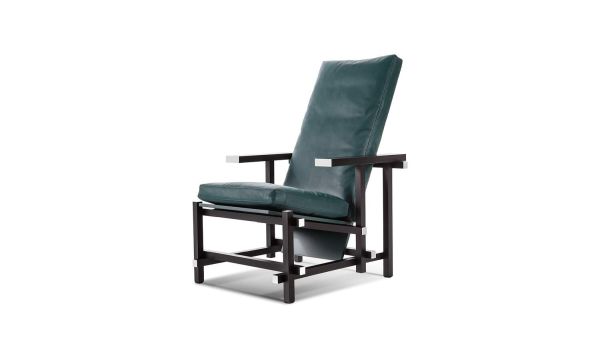


A reworking of the iconic 1918 model designed by Gerrit Thomas Rietveld, Cassina's Black Red and Blue armchair is the result of the Dutch master's tireless research into form and colour. A direct evolution of the original archetype, this version embodies the experimental spirit of the Neoplastic movement, of which Rietveld was one of the leading figures.
The first prototypes were based on the idea of rigorous spatial organisation, expressed through monochrome: the initial 1918 version was made entirely of natural, unvarnished wood. In the following years, Rietveld introduced monochrome and polychrome variations, eventually arriving at the use of primary colours, which transformed the armchair into a visual manifesto of neoplasticism.
The version selected by Cassina for the MutAzioni project dates back to the 1920s and was originally created for teacher Wicher Zeilmaker. The structure is in black-stained beech with contrasting white details, while the seat and backrest are in green lacquered plywood. For superior comfort, a single cushion for the seat and backrest is available in fabric or leather.
More than just a piece of furniture, the Cassina Black Red and Blue armchair stands out as an abstract-realist sculpture, capable of lending character and prestige to the spaces it inhabits. And although its vocation is primarily aesthetic, in the version proposed by Cassina with an integrated cushion, it can be transformed into a surprisingly comfortable seat.